English
English

The Sustainable Cable Grommet for Quick and Reliable Assembly
Recycling and resource efficiency are key levers on the road to a more sustainable automotive industry. Increasingly, even small plastic components are gaining importance — because their contribution to a vehicle’s environmental footprint is greater than it may seem at first glance.
Automotive OEs in North America have established carbon neutrality targets as part of their overall Environmental, Social and Governance (ESG) plan. The ultimate goal of achieving carbon neutrality varies by OEM; however, current targets indicate that by 2050 the Automotive industry will achieve carbon neutrality. One of the key enables is increasing the percentage of materials that are reusable or recoverable at the end of life. These targets fundamentally change how components are viewed: recyclability and resource efficiency are now just as important in design as functionality and cost.
A modern car contains several hundred plastic components — from cockpit elements to small cable fasteners. Even seemingly minor parts such as cable grommets quickly add up to millions of units in production. If made from materials that are difficult to recycle, they can have a significant negative effect on the overall balance.
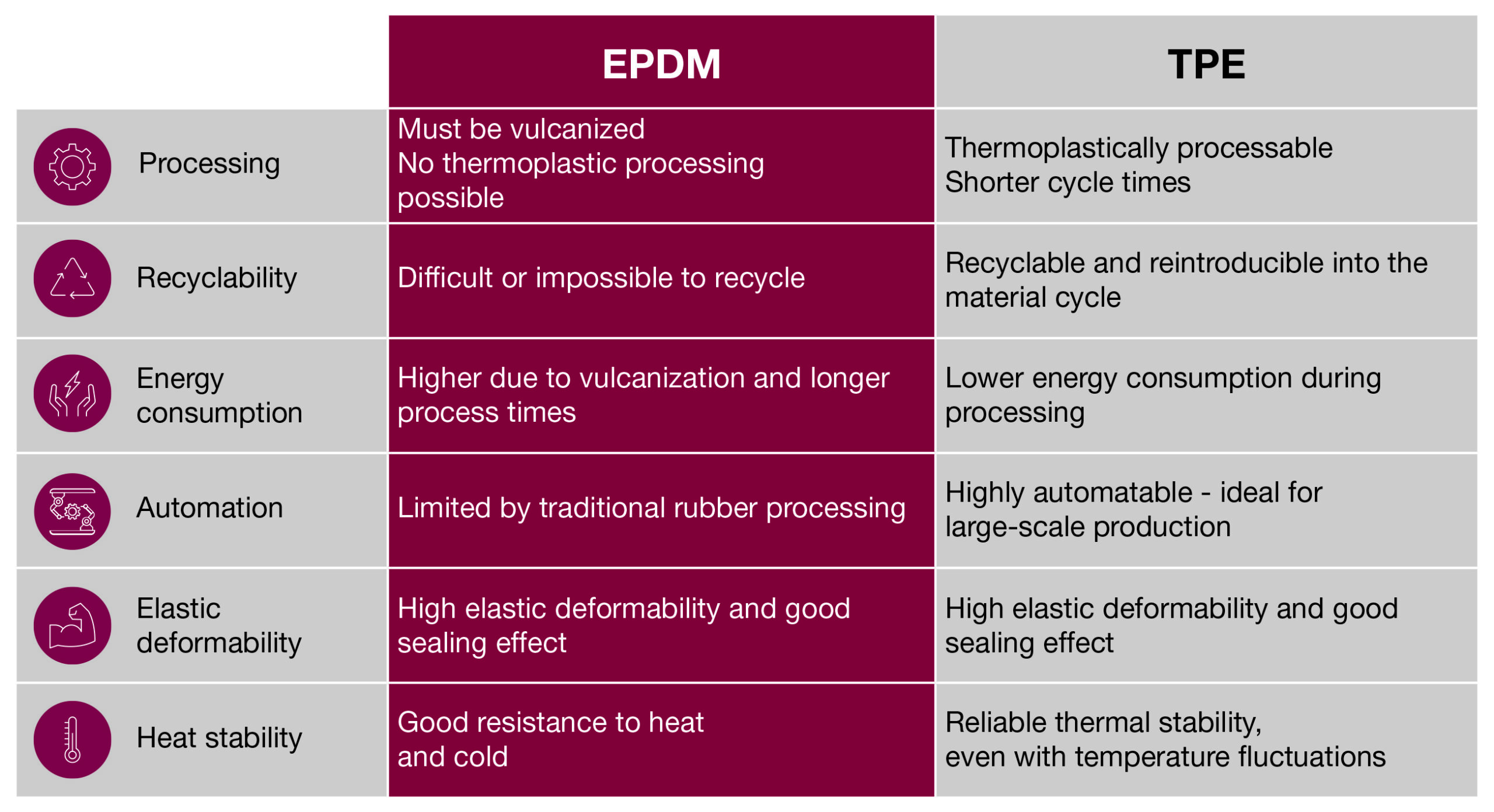
Many of these parts have traditionally been produced from elastomers such as EPDM, which cannot be thermally reprocessed — an obstacle to true circularity. Yet these very small parts hold major potential: by substituting materials and applying smarter design, weight and environmental impact can be reduced. Every material replaced helps reduce CO₂ emissions across the entire vehicle lifecycle.
Thermoplastic elastomers (TPE) offer a forward-looking alternative. Unlike conventional rubber materials, they can be thermoplastically processed, remelted, and reintroduced into the material cycle. For large-scale production, this means shorter cycle times, lower energy consumption, improved automation — and the ability to directly incorporate recycled material.
In practice, TPEs deliver high flexibility, strong sealing, and reliable thermal stability. This makes them ideal for components that are frequently assembled, moved, or exposed to temperature variations—such as cable pass-throughs inside the vehicle or in door modules.
Rethinking Assembly
The TPE Harness Grommets were designed to significantly simplify assembly processes in automotive production. Thanks to their ergonomic design, they can be installed in just seconds without the need for tools. The insertion force is minimal, while tactile, audible, and visual feedback immediately confirm proper installation. In practice, this translates into assembly time reductions of up to 90%—a benefit that quickly adds up in high-volume production.
In addition, the grommets deliver reliable sealing performance (IPX6K), temperature resistance up to 100 °C, and come in a wide range of variants for diverse installation scenarios.
Sustainability Ready for Series Production
The Greenline variant goes a step further. Up to 50% of the material used is sourced from recycled plastics, conserving resources while significantly reducing part weight. This lowers energy demand in both manufacturing and vehicle operation and improves recyclability at the end of the lifecycle. In this way, TPE Harness Greenline combines assembly efficiency with a measurable contribution to sustainability.
Key benefits at a glance:
Whether in door modules, battery housings, or body pass-throughs — the TPE Harness Greenline demonstrates that even small components can make a measurable contribution to meeting regulatory requirements and advancing the industry’s transformation toward greater sustainability.