English
English

As circularity becomes a greater focus in automotive development, engineers must consider how design decisions support dismantling, material recovery, and lifecycle goals. Fastening strategies play a key role, making it essential to define the intended recovery pathway early and validate performance throughout the product lifecycle.
A vehicle connection is usually judged at two points: installation and use. Circular design adds a third: release. Years after assembly, a clip, bolt, insert or bonded joint may determine whether a component can be serviced, removed intact or separated into a usable material stream.
The practical gap is visible in automotive plastics. European Commission research found that only 19 percent of plastic waste from end-of-life vehicles is sent for recycling. Mixed materials, contamination, limited sorting capability and weak recovery economics all contribute to that result.1
Design choices cannot solve every downstream constraint, but they establish the conditions that dismantlers and recyclers will encounter. Material selection, component access and joining methods can make recovery simpler or add time, damage and contamination to the process.
Circularity can follow several paths. Repair keeps the vehicle or component in service. Reuse preserves the component with limited rework. Remanufacturing restores it to a defined condition. Material recycling recovers polymers, metals or other feedstock for another production cycle.
Each path creates a different requirement for the attachment. A serviceable fastener may need to accommodate repeated removal and reinstallation. A component harvested for reuse may only need to be removed once, but the component and its mounting surface must remain undamaged. A fastener that stays with a polymer component may need material compatibility for recycling rather than reusability.
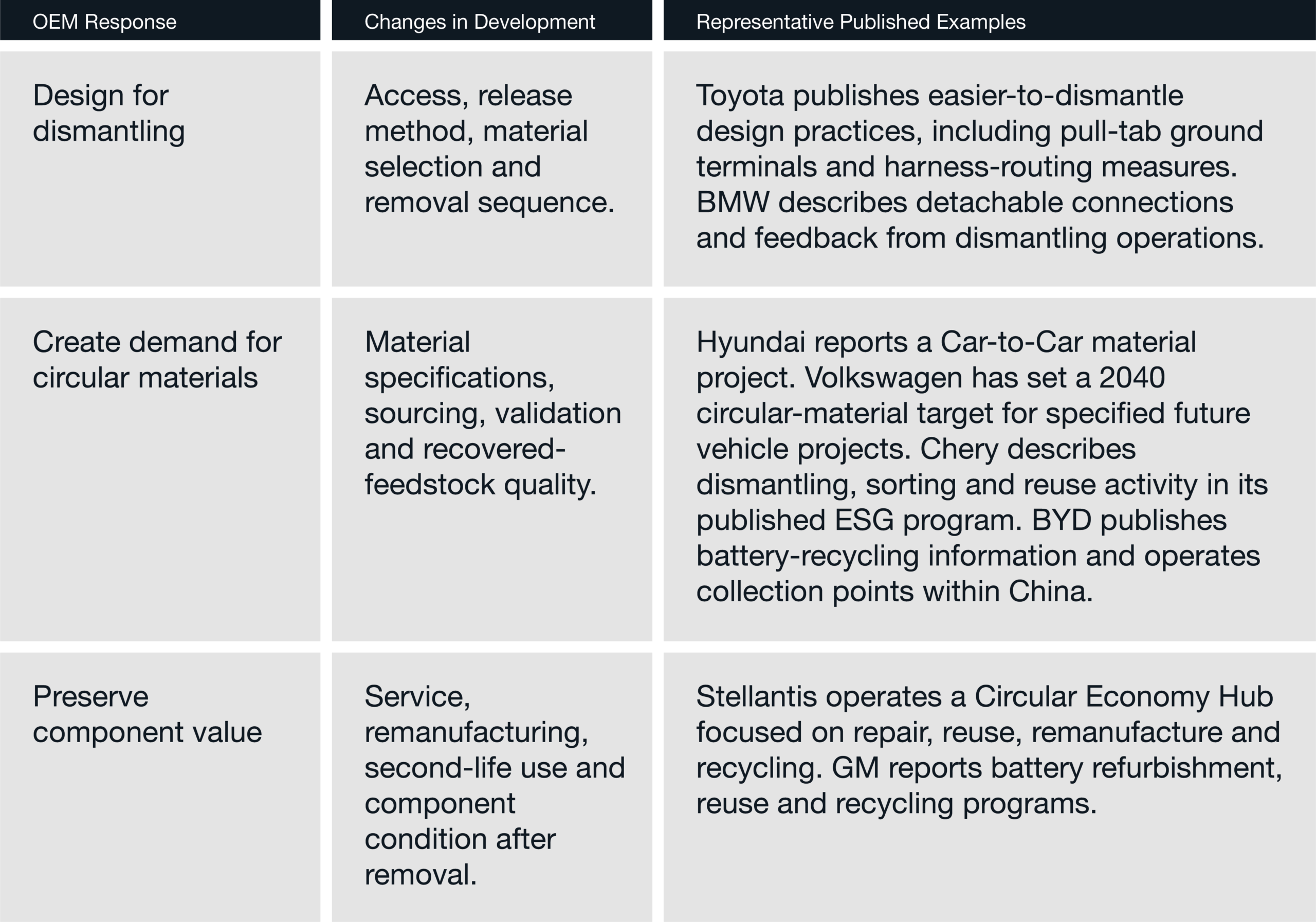
Most automotive markets are trying to recover more material value and improve access to priority components. They are using different policy tools to get there. Europe ties requirements to the approval of new vehicle types. China focuses heavily on battery identification and safe dismantling. Japan uses its established recycling system to recover more material before shredding. Korea addresses recyclable product design and recycling information. Current federal work in the United States is concentrated on batteries and critical materials.
The European Union provides the clearest timetable. Regulation (EU) 2026/1738 applies starting in September 2028. For applicable new vehicle types, it requires 15 percent post-consumer recycled plastic from September 2032 and 25 percent from September 2036. From September 2032, specified parts must be designed so their removal is unhindered, and electric-vehicle batteries, battery packs and e-drive motors must be readily and non-destructively removable and replaceable. Manufacturer circularity strategies and standardized removal information begin in 2029, followed by the Digital Circularity Vehicle Passport in 2032.2
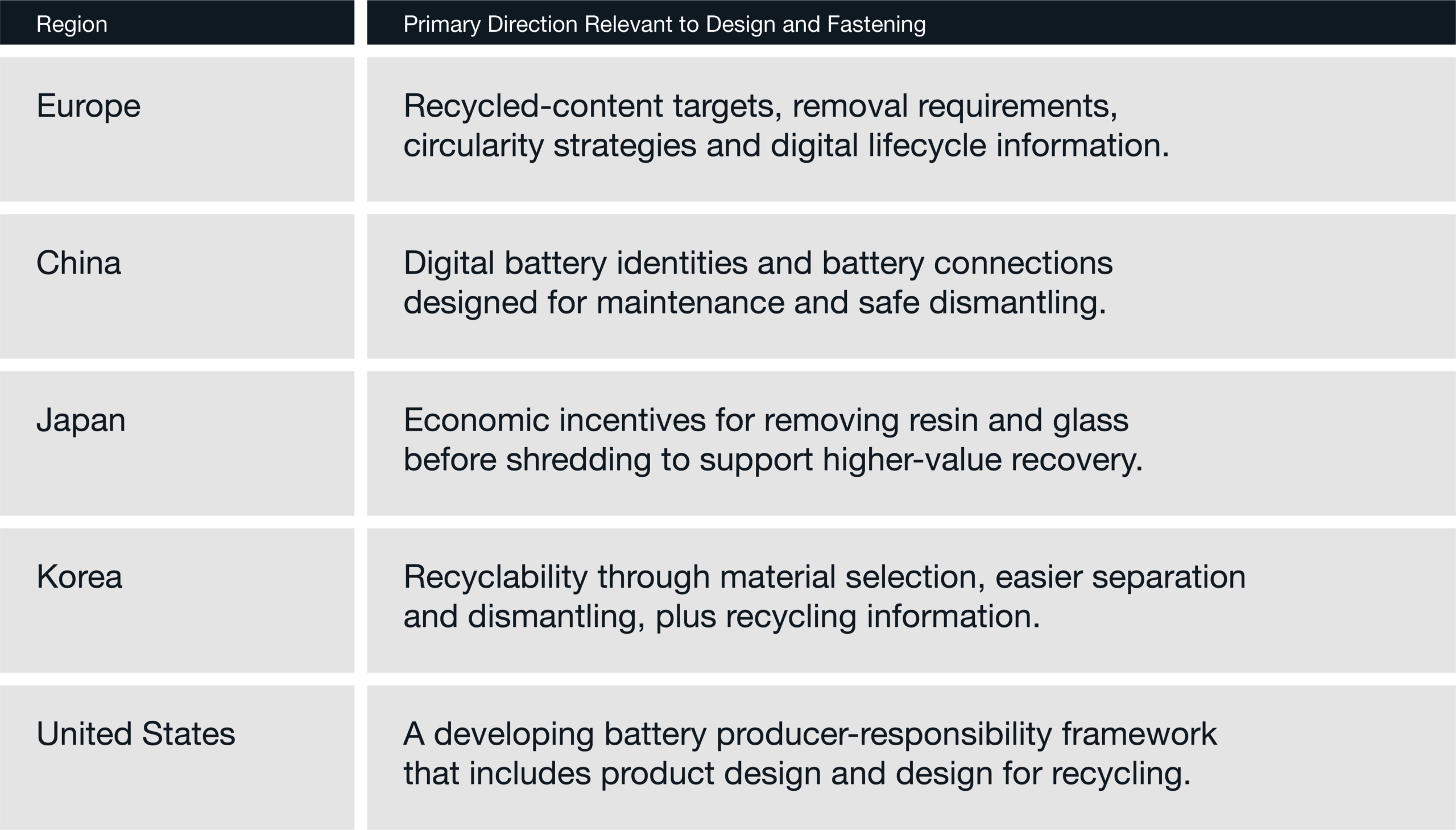
The EU regulation phases in its requirements over several years. The timeline below applies only to the European Union; other markets follow separate regulations and implementation schedules.
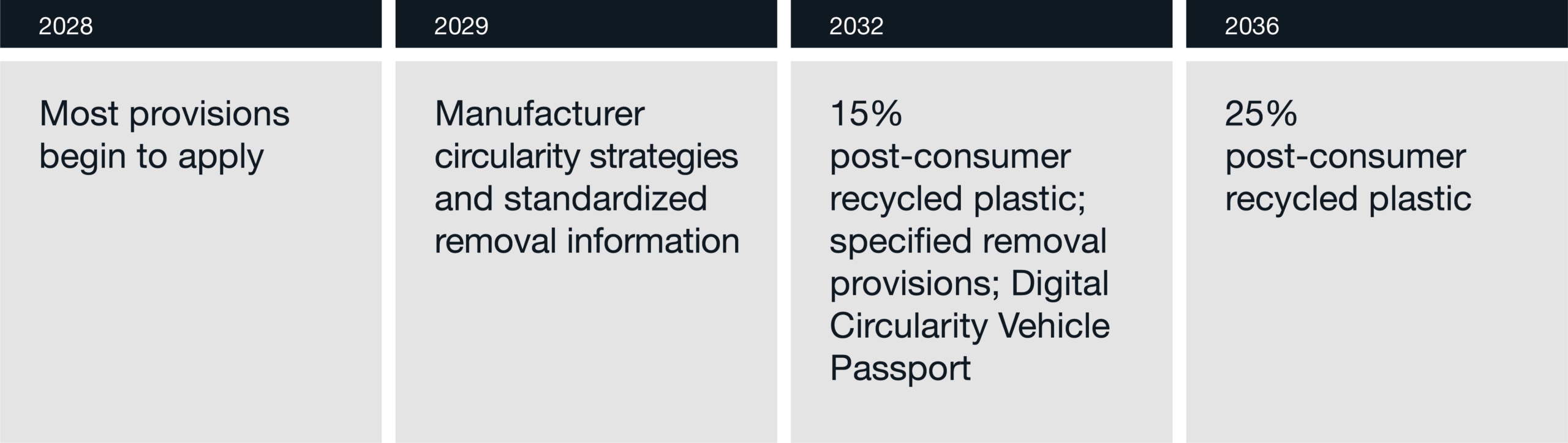
Published OEM strategies and programs point to three common responses: make priority components more practical to remove, create demand for circular materials, and preserve component value through repair, reuse or remanufacturing. OEMs are not operating to one common technical standard, but they are moving end-of-life knowledge into vehicle architecture, material specifications and supplier development.
These initiatives place new demands on component architecture, material documentation and the joining methods that determine whether priority parts can be accessed and separated.
A fastener designed to support circularity must still install reliably and retain the attached component through its required life. It may need to tolerate vibration, impact, moisture, chemicals, temperature cycling and sustained loads. Recovery adds another set of conditions to the engineering decision.
Circularity adds a design condition. It does not relax the requirements for attachment strength, sealing, durability, quality or assembly repeatability.
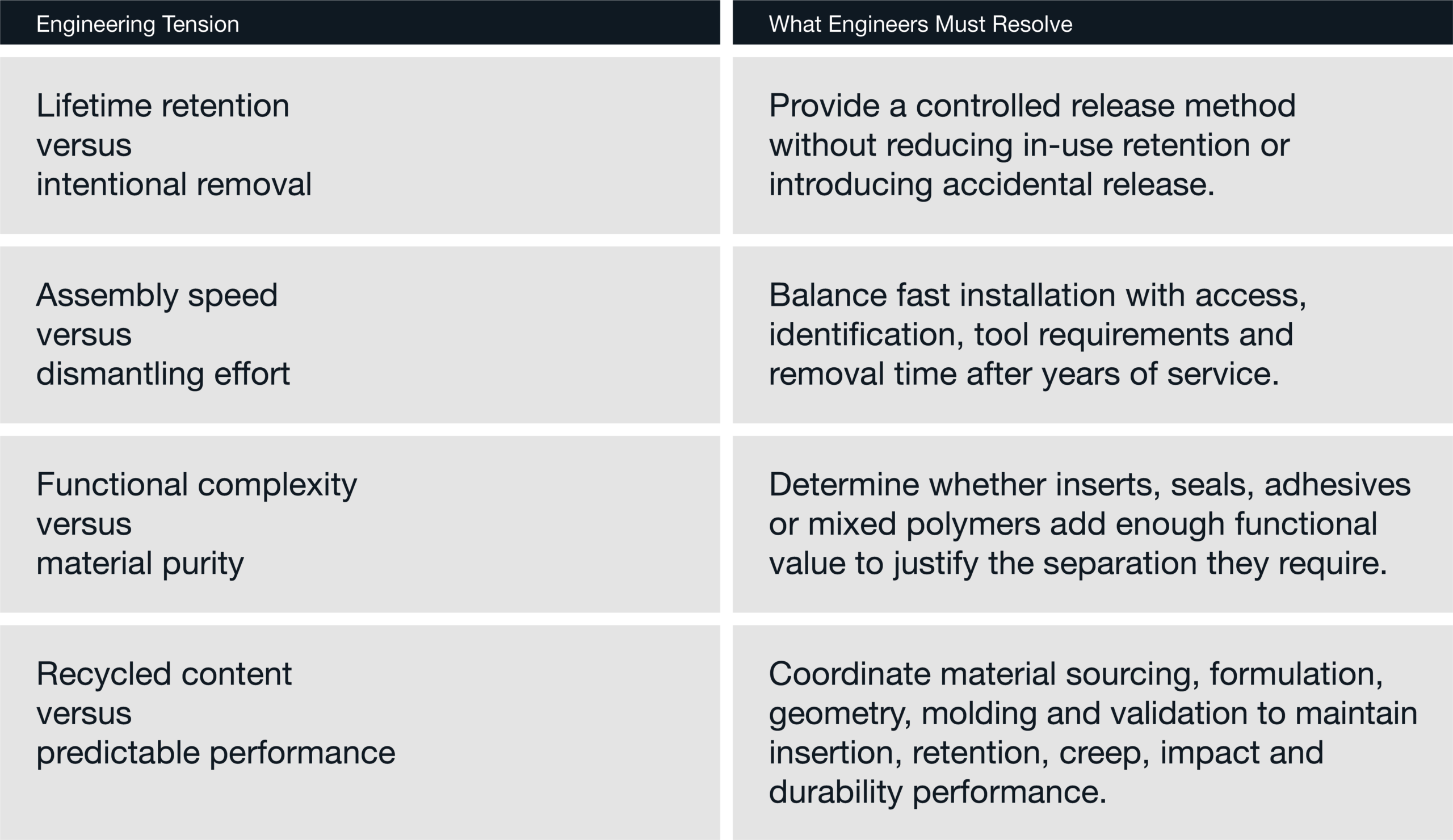
There is no single fastening strategy for circularity. The right approach depends on what needs to happen later in the component life. Some applications need a defined release method. Others benefit from keeping compatible materials together, preserving a component through repeated service, or changing the fastener material itself.
The four approaches below translate those different requirements into connection design. Each must still satisfy the attachment, assembly and vehicle-life requirements of the application.
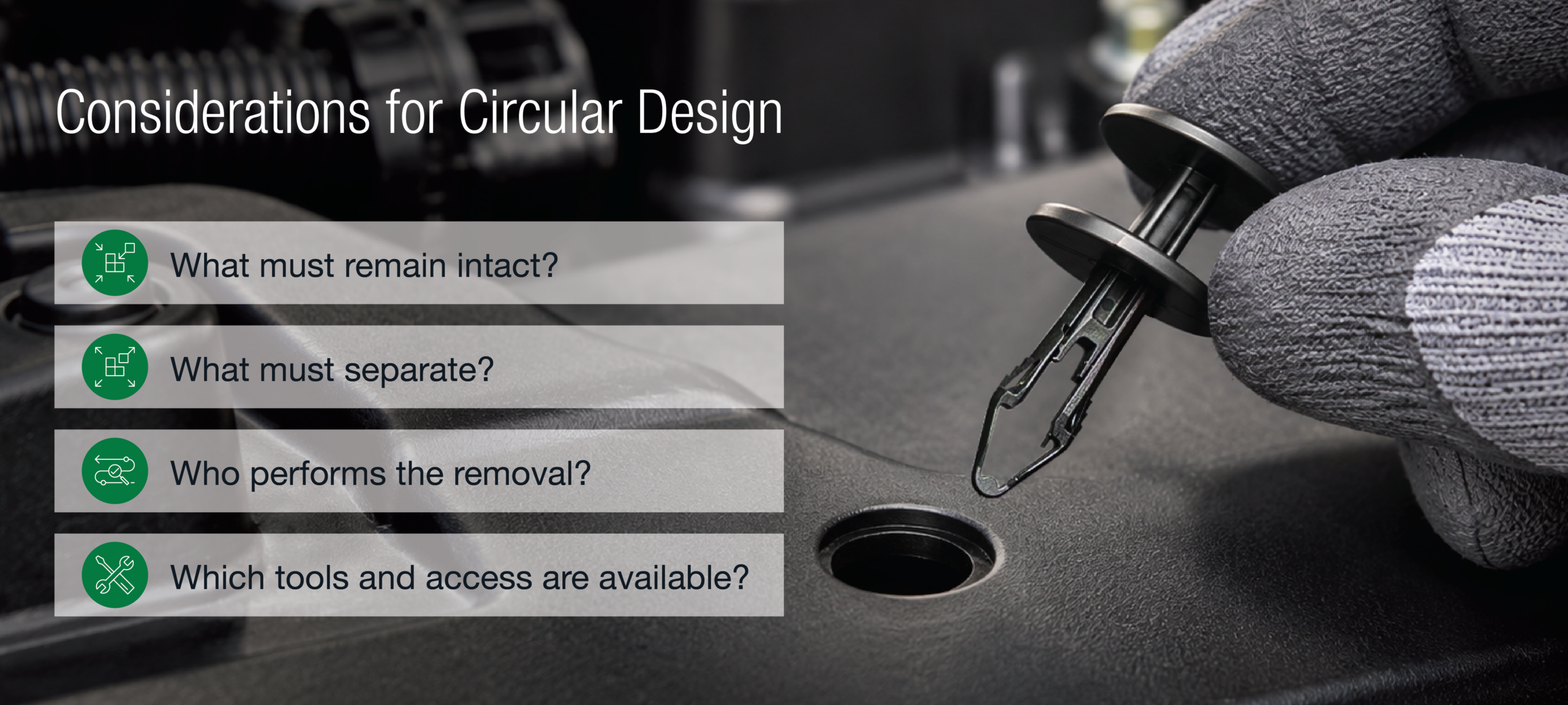
There is no single fastening strategy for circularity. The right approach depends on what needs to happen later in the component life. Some applications need a defined release method. Others benefit from keeping compatible materials together, preserving a component through repeated service, or changing the fastener material itself.
The four approaches below translate those different requirements into connection design. Each must still satisfy the attachment, assembly and vehicle-life requirements of the application.
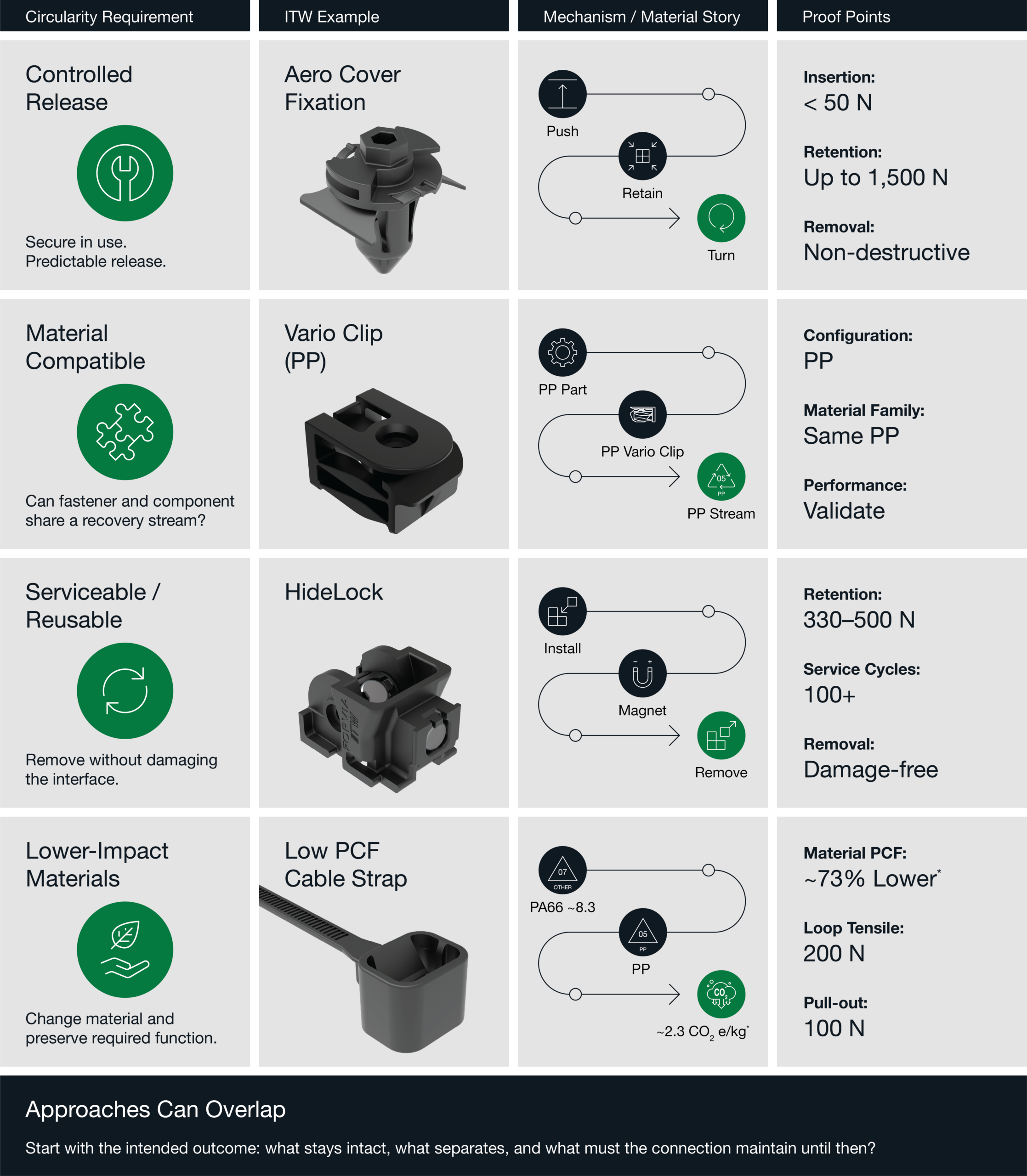
ITW recommends starting with the intended recovery outcome, then working backward to define what must remain intact, which materials must separate, how the connection will be accessed and released, and what performance must be validated.
The fastener must perform during assembly and throughout the vehicle life. Where component or material recovery is intended, it must also enable the final operation that releases the part or separates its materials. Defining that operation early gives engineering teams more options to balance access, attachment performance, material compatibility and removal.
ITW Automotive can work with vehicle and component teams to define the recovery pathway, assess the application and evaluate connection concepts against assembly, vehicle-life and removal requirements.


Endnotes